AI built for adults is dangerous for a child. Yours is already using one.
Gnappo is the one that was built for them. It is the AI that knows your child — and tells you what happened today: a guarded place to ask anything, practice questions in six subjects pitched to where they actually are, and a one-page account every evening, with a message within minutes if something matters.
Closed beta · Never used to train AI
That is not a worry. It is a measurement.
Not next year, and not when they are older. It is happening now — on a phone, in a product built for adults, with no floor under it and nobody reading it afterwards. The research stopped being ambiguous a while ago.
of US children aged 9 to 17 use AI. 81% of the 9-to-12s, rising to 92% at 16 and 17 — and one in six of the youngest uses it every day.
Common Sense Media Census, AI Use by Tweens and Teens · 1,204 US children aged 9–17, 2026children say no parent or guardian has ever talked with them about using AI safely. They worked it out alone, from the product itself.
Common Sense Media Census · same survey of 1,204 US children, 2026of students used AI for their homework by December 2025 — up from 48% seven months earlier. A chatbot is now the tool they reach for first.
RAND, More Students Use AI for Homework · American Youth Panel, US students surveyed May and December 2025of the children who use AI have used it to discuss their feelings or personal problems. More than half have asked it about their health or their body.
Common Sense Media Census · same survey of 1,204 US children, 2026None of this is an argument for keeping a child away from AI. That is not a choice a parent really gets any more, and the tools are genuinely useful. It is an argument for the one they use being built for a child in the first place — which is the whole of what Gnappo is, and the whole of it is below.
Two products, one subscription.
Your child gets a tutor they can ask anything. You get a written account of every day, and a message the moment it matters.
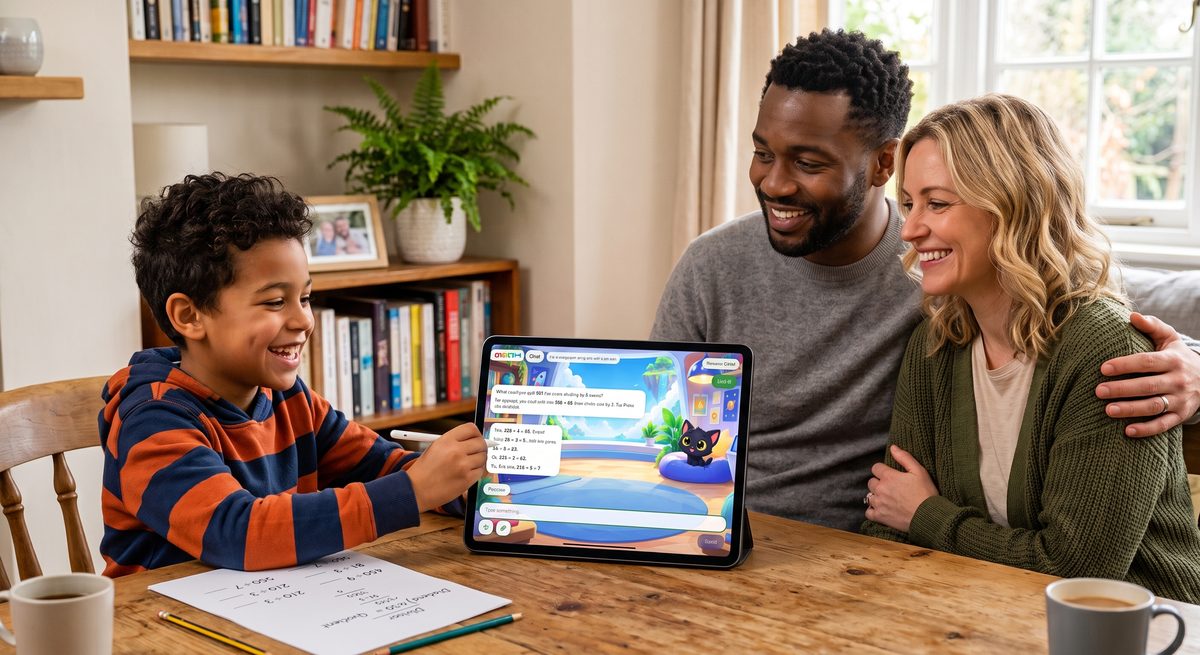
Questions written for the grade your child is actually on.
Gnappo is not only somewhere to ask things. It asks back — six subjects, every question written for a US grade level and a named skill inside it, and pitched at where your child actually is in that particular subject rather than where the school year says they should be.
Grade 1 to 12 — and four rungs past the end of school
Because a child does occasionally run out of grades, and more of them do it here than the grades allow for. This ladder describes the questions, never the child.
- Grade 1
- 2
- 3
- 4
- 5
- 6
- 7
- 8
- 9
- 10
- 11
- Grade 12
- Amateur
- Pro
- Expert
- Guru
The same feature reads differently depending on who is teaching. If your child is at school, the record fills the gap a report card leaves and the half you arrived worried about is homework — Gnappo for a child at school. If you teach them at home, you are the teacher as well as the parent and this simply is the record — Gnappo for homeschoolers, including what we can and cannot yet say about paying for it with a scholarship.
The homework help that refuses to do the homework.
Every other assistant is safe enough to finish your child's worksheet for them. That is the problem, not the feature. Gnappo helps them learn the thing — and you decide how much of the thinking it is allowed to do.
Asked outright. Still no. It wants an attempt first — a switch you turn on, and the highest-signal thing in the feature. A child who cannot say what they have tried has not read the question.
Then it checks the help landed. One more question afterwards, a different one of the same shape — never the same one handed back. It is what turns “did they actually follow that?” from a guess into something your evening summary can count.
One rule here is not a setting, and no rung reaches it. Gnappo never writes the thing that gets handed in — no complete essay, no finished worksheet, no whole lab report, no paragraph written to be pasted. It explains, it works through examples of its own, and it gives an opinion on a draft your child wrote. Ask it to write the essay and it will say, warmly, that it has to be in their words and offer to help them get there. It will not do a whole assignment in one go either, however many questions are pasted at once. Whatever else is set, this decides whose name is on the work, and it is the difference between a tutor and a plagiarism engine.
It knows when it is schoolwork
Homework is recognised as it happens, so your evening summary has a section of its own for it: which subjects, what they actually got, and where they kept getting stuck.
Counts, never a mark
“Followed up on 2 of 7 check-backs. Asked for the answer outright 9 times.” Never a percentage, a level or a predicted grade. Gnappo describes an evening; it does not assess a child, and there is deliberately nowhere for a score to be kept.
Photograph the page
Stuck on question four? Take a picture of it. Gnappo reads what is on the page — your child's own workings and crossings-out included — and then deletes the photo in the same moment. Off until you switch it on.
The conversations you would not have had
One your child was not going to bring to you, one they were never going to ask you, and one you would want to hear about inside the minute. All three really happen. All three end up on your side of the product — and not one of them gets there the same way.
Gnappo · to you · 16:42
Gnappo — Please take a look: Peter
Peter said something in Gnappo that we think you should see.
The conversation is waiting for you in Gnappo. We have not put it in this email on purpose.
Open it in GnappoHe asked it not to tell you. It told you. Gnappo is not a place to keep something from a parent, and that is not a setting either — it is the same rule that stops it holding a secret for anybody else. The alert goes out as the flag is raised, and the conversation is already open at that moment when you follow the link.
Tonight's summary · 19:04
Blocked by your family (sex) — Maria asked, Gnappo declined and pointed her at you. No email was sent.
It matched the subject, not your word for it. You typed “sex”. She typed a question that does not contain it. A list of banned words would have answered her; the classifier reads what the message is about, so the thing you asked to be left to you was left to you.
And it did not wake you up for it. A blocked subject is worth knowing and is not an emergency, so it waits for the evening summary. Emails are reserved for the severities that earn one — and if you want them sooner than that, you can lower the threshold yourself.
Gnappo · to you · 21:12
Gnappo — Please take a look: John
John said something in Gnappo that we think you should see.
The conversation is waiting for you in Gnappo. We have not put it in this email on purpose.
Open it in GnappoNobody generated that answer. A reply written on the spot for a child in trouble is a reply no one has read before it reaches them. At this severity Gnappo does not write one: the words are people's, they were reviewed, and they are the same every time. They believe him, they send him to a person, and they never once pretend to be one.
Nothing had to be working for this to fire. The phrase he typed is on a list Gnappo checks itself, with no model and no network in the loop. The classifier is what catches the message that says the same thing in words nobody listed — but this half still answers on the evening every provider is down, which is exactly the evening you would least like the floor to be missing.
Gnappo already knows what you would tell a new teacher.
Every child has something. He takes things literally; she loses the thread halfway through a long answer; his grandmother died in the spring and nobody mentions it. A generic assistant meets all of them the same way, because it has never been told.
So you write it down once, and every answer changes
Not a disclaimer bolted onto an answer, and never a moment where your child is told they are being handled differently — it is simply how Gnappo speaks to them, from the first message on.
“He’s autistic and takes things literally.”
Gnappo, from then on
- Literal, concrete language. No idioms, sarcasm or irony.
- One thing at a time, and it waits for a reply before adding more.
- Says what it is going to do, then does it. No abrupt change of subject.
- No urgency, no countdowns, nothing exclamation-heavy.
“ADHD — he loses the thread if the answer is long.”
Gnappo, from then on
- Short answers, broken into small steps.
- The answer first, the explanation after it.
- One suggestion at a time, never a long list of choices.
“Hates loud noises. Her dad died in March.”
Gnappo, from then on
- Short and calm when she seems overwhelmed. No jokes, no extra energy at those moments.
- Gentle about death and sudden loss — and it never raises the subject itself.
- If she raises it: warm, brief, no probing, and a note in your evening summary.
Your sentence, not our dropdown. No list of conditions to tick — you write what you would tell a new teacher, in any combination, and every set of directions it earns applies at once. And the diagnosis never leaves our database: the large language model receives the directions above, never the words you typed. Gnappo does not decide your child “seems autistic”, either — only you say what is true about them.
The promises that are architecture, not policy.
Each of these is a decision written into how Gnappo is built, which is a different thing from a line in a policy that a future release could quietly drop.
-
No third-party analytics. Ever.Nothing on a child’s screen reports to anybody else — no trackers, no tag managers, no pixels.
-
Never used to train AI.Not by us, and not by our model vendors — who are contracted to zero retention and no training.
-
A photo is read, then deleted.Inside the same request, always — we store no picture a child sends, so there is none to leak, none to hand over, and none to show you. You read what Gnappo read instead.
-
No child ever meets another child here.No sharing, no galleries, no friends, no user-made bots. There is nobody else in the room.
-
The safety floor cannot be switched off.Not by a setting, not by us, not by support. You may add rules and tighten them — never remove the floor.
Gnappo is not a therapist, a doctor or an emergency service, and it says so to your child rather than only to you. If a child raises self-harm, it shows crisis help in the conversation at the same moment it tells you. Read the Privacy Policy and Terms for exactly what that means.
The things parents actually ask first.
What age is Gnappo for?
Gnappo is built for children roughly 6 to 14. How it answers is set by an age band — under 7, 7 to 9, 10 to 12, 13 to 15, and 16 plus — so the same question gets a different answer for a six-year-old than for a thirteen-year-old. A parent creates every child profile; a child can never open an account.
Can I read what my child says to Gnappo?
Yes. Every conversation, for every child on your account, plus a one-page summary each evening. For a child aged 14 or older we tell them, in their own words at the start of every session, that you can read it. We will not provide covert monitoring of a teenager.
Is my child's data used to train AI?
Never. Not by us, and not by our two model vendors, who are contracted to zero retention and no training on the content. We also run no third-party analytics anywhere a child can reach, and never sell or rent personal information.
How does Gnappo help a child with ADHD or autism?
You tell Gnappo, in your own words, what is true about your child. Gnappo derives behavioural directions from that — prefer literal language, avoid idioms, answer in short steps, be gentle about a particular topic — and only those directions reach the model; the diagnosis itself never leaves our database. There is also a calm mode that stops every animation, sound and ambient effect on the child's screen.
Does Gnappo teach anything, or does it only answer questions?
Both, and the practice half is the one that grew most recently. Alongside chat, Gnappo asks your child practice questions — six subjects, and every question written for a US grade level from 1 to 12 and for a named skill inside it. They arrive in the conversation your child is already in, a few at a time, pitched to where that child actually is in that particular subject, and often about whatever they were just talking about. Every question is checked three times before it can be asked: a deterministic pass, an exact-arithmetic check on anything with a sum in it, and a person who approves it one question at a time. You get the record — how many, in which subjects, over which weeks, and the last twenty answers in your child's own words. There is no test, no mark and no rank in any of it. There is a page for a child at school and one for a child taught at home.
Will Gnappo just do my child's homework for them?
No, and how far it goes is yours to set — four rungs per child. Questions and decomposition only, never the solution even when asked directly. Hints that get more concrete once your child has shown an attempt. The method worked through, then “now you try one”. Or the answer on request, for a parent who wants a reference. Hints is the default from about ten upwards; younger children start on the worked method, because a seven-year-old has to see a thing done before they can do it. Underneath all four sits one rule no setting reaches: Gnappo never produces a finished piece of work to be handed in — not a complete essay, not a filled-in worksheet, not a paragraph written to be pasted. It explains, it works examples, and it critiques a draft your child wrote themselves. The rungs decide how much of the thinking Gnappo does; that line decides whose name is on the work, and it is not a setting.
How do I know whether my child actually understood any of it?
After it has helped, Gnappo asks one question back that only somebody who followed the explanation can answer — a different question, not the same one returned. You can also have it ask “what have you tried so far?” before it helps at all, which is the single most telling thing in the feature: a child who cannot answer it has not read the question. Your evening summary then says something like “asked for the answer nine times, passed the check-back on two of seven”, instead of leaving you to guess. It is not a score and it never becomes one. Nothing here is graded, ranked, or shown to your child as a number.
Can my child take a photo of their homework?
Yes, once you switch it on for that child — a photograph, a PDF or a text file. Gnappo reads what is on the page, your child's own workings and crossings-out included, so the help is about the actual question rather than a retyped version of it. The file is deleted in the same moment it is read: we store no picture, which means we cannot show one back to you either. What you see in the conversation is the full text of what Gnappo read. It stays off until you turn it on, because a camera in a child's hand is a decision for you to make rather than a default for us to pick.
Does Gnappo pretend to be my child's friend?
No. Gnappo tells your child it is a computer at the start of every session, and it will not claim to be a doctor, therapist, teacher or friend. There is no persistent companion persona, no simulated affection, and no streaks or notifications pulling a child back.
What happens if a child says something worrying?
Gnappo shows the child real crisis help inside the conversation at the same moment it messages you, usually within minutes, with the conversation open at the point it happened. Detection is best-effort with human review of the alert — no service can honestly promise to catch everything — and the whole decision is written to an audit record that cannot be quietly edited.
What happens if I stop paying?
Your plan runs to the end of the period you have already paid for, and then the paid features stop. Then we email — when the plan lapses, midway, and once more near the end — and if nothing changes we close the account 30 days after the lapse and destroy what is under it: transcripts, summaries, and the sensitive profile with its key, everything except the safety audit trail and the billing records tax law makes us keep. Start paying again at any point inside those 30 days and nothing is lost; export everything at any point before the end. We will not sit on a child's data for a service you are not using — that is storage limitation under the GDPR, and it is written into the Terms and the Privacy Policy rather than promised on a marketing page.
Can my child talk to other children on Gnappo?
No, and this is deliberate rather than unbuilt. There is no sharing, no gallery, no friend list and no user-made bots. Anything your child makes is visible only to them and to you. One line keeps Gnappo out of the entire content-moderation business and keeps strangers away from your child.
Gnappo is in a closed beta.
We are letting families in a few at a time, so that every child on it gets the attention the guardrails need. Tell us about yours and we will write when there is room.
Ask for a place